
How old is Makima? Makima’s exact age is not officially confirmed in Chainsaw Man, which is why most reliable answers focus on what the story shows: she appears as an adult woman while her true nature makes her “age” hard to measure like a normal human. In this ComicK analysis, we separate Makima age (canon) from Makima’s apparent age, then use clear story clues and manga logic to explain why her ageless power is part of the horror.
Keep reading to uncover the 5 dark secrets that make Makima impossible to pin down.
How Old Is Makima Really?
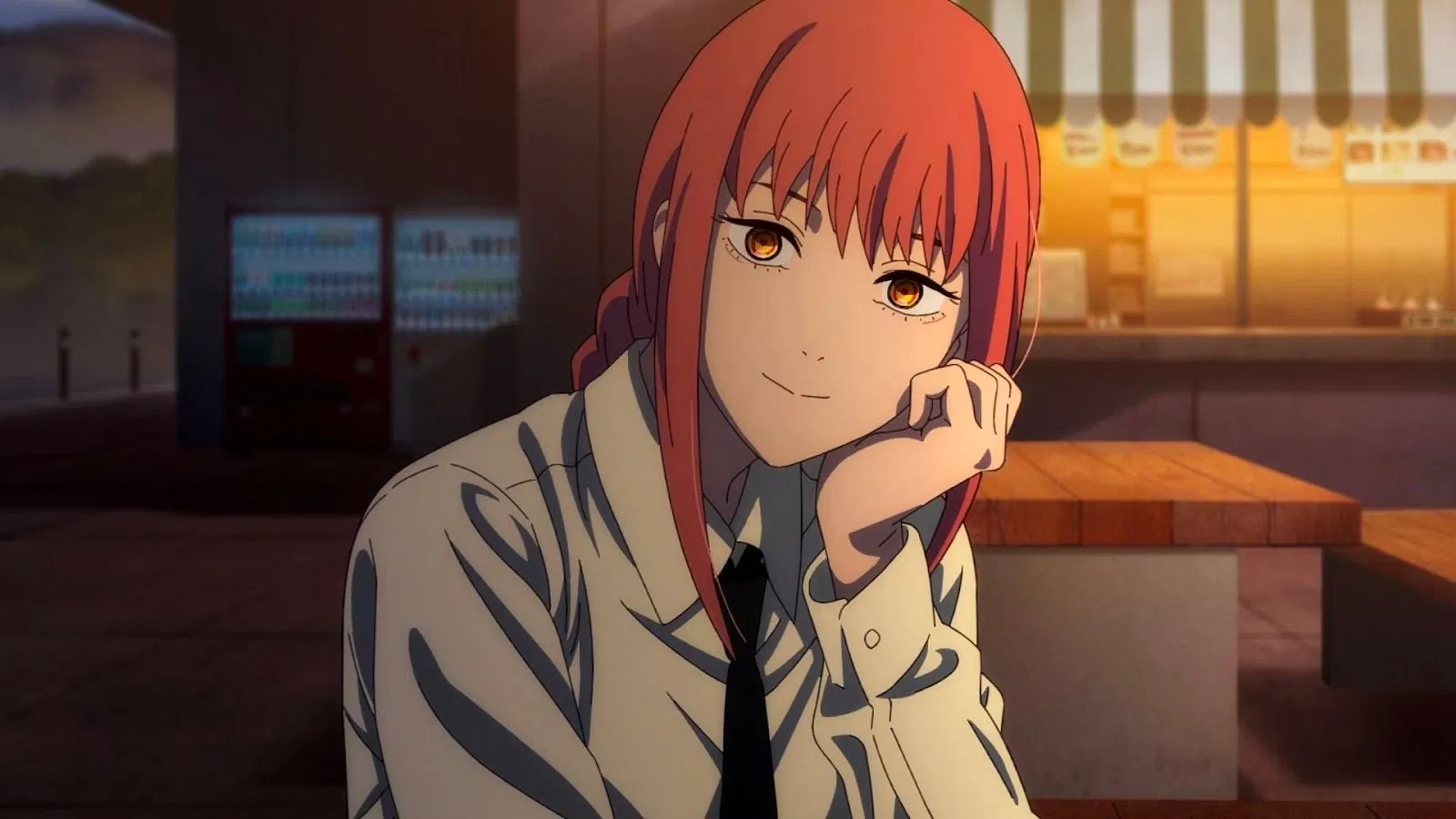
If you need a concise line that is accurate and does not overclaim:
- Makima’s age is unknown in canon.
- She presents as an adult (commonly interpreted as mid-20s to early-30s in appearance).
- Her true age is not comparable to a normal human lifespan.
Now let’s unpack why this is the only responsible answer, and why the ambiguity is one of the darkest pieces of her power.
Why the Question “How Old Is Makima” Has No Canon Number
Chainsaw Man is not a franchise that forgets details by accident. When the story wants you to know something, it makes it explicit. When it does not, it is often because the uncertainty is part of the horror.
Makima exists in a narrative built on informational imbalance:
- The government knows things the public does not.
- Public Safety knows things ordinary devil hunters do not.
- Makima knows things almost nobody else does.
When a character is built to be an instrument of control, even basic biography becomes a weapon. Age is one of the easiest ways for readers to humanize a character, so the story withholds it.
Two different questions hiding inside one keyword
When people ask how old is Makima, they are usually combining two different questions:
- Apparent age: How old does she look and read socially?
- True age: How long has the entity behind the face existed?
Chainsaw Man wants you to confuse these, because confusion makes you easier to guide.
Makima’s Apparent Age: What the Story Signals Without Confirming
Makima is framed as an adult in nearly every social cue the series offers. Even without a number, you can make a reasonable reading based on presentation.
The professional and social coding is deliberate
Makima is consistently depicted with adult-coded markers:
- A senior professional role with authority over experienced hunters.
- A calm, managerial demeanor rather than youthful impulsiveness.
- A power dynamic with Denji that reads like boss, handler, and gatekeeper, not peer.
These signals do not confirm a specific age, but they clearly place her in “adult” territory. That is why most viewers do not interpret her as a teenager, and also why she rarely reads as older in a conventional “middle-aged” way. She is engineered to sit in an unsettling middle: mature enough to command, young enough to feel approachable, polished enough to feel trustworthy.
A practical estimate that stays honest
If you are writing commentary or answering casually, many readers estimate:
- Makima appears around her mid-20s to early-30s.
This is not canon. It is an interpretation of how she is framed: her look, role, and the way others respond to her.
The Real Problem: Makima’s “True Age” Does Not Work Like a Human’s
Makima’s “ageless” feeling comes from more than her appearance. It comes from the fact that her existence is tied to rules that break normal human life logic.
Humans age along a simple line: birth, childhood, adulthood, decline. Makima does not fit that model because her identity is rooted in devil metaphysics: fear, contracts, and continuity that can outlive any single human life.
That is why the keyword question is not solved by guessing a number. The series is telling you that the number is not the point.
The 5 Dark Secrets Behind Makima’s Ageless Power
The title promise matters, so here are the five “secrets” that actually answer the search intent: why her age is unknown, why she feels ageless, and how that connects to her power.
Dark Secret 1: Withholding Her Age Is a Form of Control
Makima is not just powerful. She is structurally powerful. She wins by controlling the frame in which other people think.
Age is a framing tool. When you know someone’s age, you unconsciously create an explanatory narrative:
- What generation they belong to
- What they likely experienced growing up
- What limits and vulnerabilities they might have
- What peer group they probably have
Makima is written to resist that. She is introduced as if she is already complete, already positioned, already above explanation.
What the missing age accomplishes
- It blocks familiarity.
You cannot reduce her to “someone like you.” - It strengthens authority.
If you cannot place her, you cannot challenge her on equal footing. - It keeps moral evaluation unstable.
The audience is forced to confront power dynamics directly instead of rationalizing them away.
ComicK team note: on re-read, the missing age reads less like a trivia omission and more like a design choice to keep Makima psychologically unreachable.
Dark Secret 2: Her “Age” Is Conceptual, Not Biological
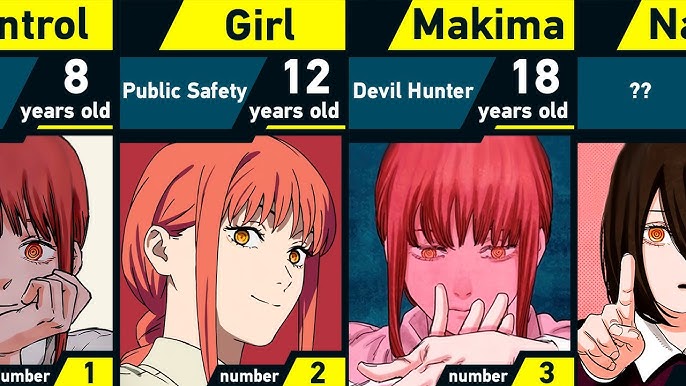
Makima’s core power is not presented like a skill learned over time. It is presented like a property of what she is. That distinction matters for age.
A normal human’s capabilities are tied to time:
- training
- experience
- physical limits
- accumulation of knowledge
Makima’s capabilities feel pre-installed. That is why she reads as “ageless.” It is the sensation of encountering a force rather than a person.
The key idea: concept beats chronology
In Chainsaw Man, devils are shaped by fear. Fear is older than any person, and it can persist regardless of bodies. If Makima’s identity is bound to a concept, then:
- Her “birth” is not a human birth event.
- Her continuity is not dependent on one human lifespan.
- Her “age” becomes a category error.
This does not require you to claim a number like 100, 1,000, or 10,000. The story does not give you that. The meaningful point is simpler: Makima’s identity is not constrained by normal human aging logic.
Dark Secret 3: Her Authority Functions Like Proof She Does Not Play by Human Rules
One of the fastest ways to spot a character who is not operating like a normal human is to watch how institutions treat them.
A government agency typically runs on:
- documentation
- verification
- chains of command
- accountability
Makima moves through institutional power as if those systems exist for others, not for her. She is not framed as someone who climbed the ladder. She is framed as someone who is the ladder.
Signs the story uses to imply “beyond normal biography”
- People obey her quickly, even when it is irrational.
This suggests social and psychological pressure that goes beyond rank. - Her influence reaches into spaces that should resist it.
That suggests leverage that is not merely professional. - She treats human life as an administrative variable.
That suggests a worldview detached from ordinary human time and consequence.
When a character is written this way, “How old are they?” stops being a biography question and becomes a horror question: What is this thing that can bend systems?
Dark Secret 4: “Ageless” Is Also a Survival Property
Makima’s ageless aura is reinforced by how she behaves in danger. Many characters in Chainsaw Man are brave. Makima is not framed as brave. She is framed as certain.
Certainty is not the same as courage. Courage implies risk. Makima behaves like risk is a negotiable detail.
What this looks like on the page
- She remains calm in situations that destroy other people.
Calm is not personality here. It is an indicator of advantage. - She uses violence without visible cost to herself.
Many characters sacrifice health, lifespan, or sanity for power. Makima’s “cost” is often externalized onto others. - Her posture is predatory, not defensive.
Defensive characters worry about survival. Makima assumes survival.
This is one reason fans describe her as “ageless.” She does not move like someone who fears time, injury, or death in the way humans do.
Dark Secret 5: The Series Breaks the Meaning of Age Through Continuity and Identity
Even if you ignore spoilers, Chainsaw Man repeatedly challenges the idea that identity equals one body, one life, one timeline.
That has huge implications for Makima:
- If identity can persist beyond bodily death, what does “years old” even mean?
- If a being can reappear in new form, where does age begin and end?
- If memory and selfhood are unstable, is the “same person” old, young, or something else entirely?
These are not abstract philosophy questions. They are the mechanics that make Makima’s existence feel like a paradox. The “ageless power” is the sense that she is not bounded by a human lifecycle, even when she wears a human face.
What the Story Lets You Infer Without Lying
Chainsaw Man fans sometimes fill gaps with confident claims, and that is where misinformation spreads. Here is what you can infer safely.
Safe inference: Makima is an adult in presentation
This is supported by role, framing, and how characters treat her.
Safe inference: her true age is unknown and not human-like
This is supported by the story’s refusal to provide a number and by the metaphysical structure of devils and fear-based power.
Unsafe claim: “Makima is exactly X years old”
Unless you are quoting a verified, official statement, this is not safe. The series does not provide a confirmed number in the main narrative.
Why Fans Keep Demanding a Number
It is worth acknowledging why this keyword is so common: age is a moral tool.
People want a number because it helps them evaluate:
- the Denji dynamic
- consent and manipulation
- how “human” Makima should be treated in interpretation
- whether her career and authority make sense on a normal timeline
Chainsaw Man is intentionally hostile to that desire. It wants you to sit in the discomfort that a number would soothe.
ComicK team note: readers often discover that the urge to calculate Makima’s age is the same urge she exploits in-universe: the urge to turn uncertainty into a manageable story.
Makima’s Age in the Anime vs the Manga
A very common follow-up search is whether the anime clarifies what the manga does not.
It does not. The anime adaptation preserves Makima’s ambiguity. It emphasizes her authority and presence, but it does not attach a specific age label that resolves the question.
So for practical purposes:
- Makima’s age is unknown in both anime and manga.
- Her apparent adult presentation remains consistent across both.
How to Answer “How Old Is Makima” in Different Contexts
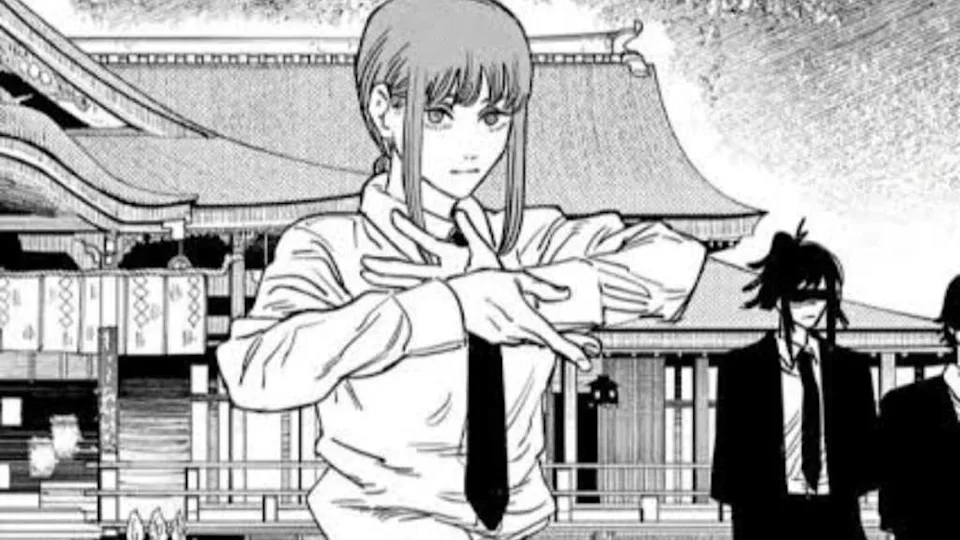
Different audiences need different levels of detail. Here are ready-to-use answers you can adapt.
If you need a one-sentence answer
Makima’s exact age is not stated; she appears adult, but her true age cannot be measured like a human’s.
If you need a two-sentence answer with context
Makima’s age is unknown in canon, which is deliberate. She is framed as an adult woman, while her identity and powers suggest she does not follow normal human aging rules.
If you are writing analysis or SEO content
Makima’s numeric age is not confirmed, and the absence functions as a narrative device that reinforces her control, mythic presence, and non-human continuity.
Why the Unknown Age Makes Makima More Terrifying
Makima is frightening for many reasons: calm cruelty, strategic manipulation, institutional leverage. But the unknown age adds a subtler layer.
Age is normally a vulnerability marker:
- Young implies inexperience.
- Old implies decline.
- Middle implies specific limitations.
Makima sits outside all of that. She is “adult enough” to dominate and “undefined enough” to feel timeless. That combination creates a psychological effect similar to encountering a predator that does not tire.
ComicK Perspective: The Most Useful Reading of Makima’s “Age”
From the ComicK team’s editorial lens, the most productive way to interpret the question is this:
- Makima’s “age” is not a fact to uncover.
- It is a signal the story refuses to give.
- That refusal is part of what makes her effective as an antagonist.
If you treat her like a normal person with a normal timeline, you miss what the narrative is doing. Makima is constructed as a pressure system: she compresses other characters’ agency until they break. A confirmed age would make her easier to humanize, and Chainsaw Man does not want that.
Conclusion: The Truth Behind “How Old Is Makima”
So, how old is Makima really?
- Canon does not give an exact number.
- She presents as an adult woman in appearance and social role.
- Her true age is not meaningfully human, because her identity is tied to powers and continuity that outlast ordinary lifespans.
If you want the cleanest takeaway: Makima feels ageless because she is written as something you cannot place, and therefore cannot safely resist.
FAQ: How Old Is Makima?
Is Makima’s age officially confirmed?
No. Chainsaw Man does not provide a confirmed numeric age for Makima in the main story.
How old does Makima look?
She is presented as an adult woman, often interpreted by viewers as mid-20s to early-30s based on appearance and authority.
How old is Makima in the anime?
The anime does not state a specific age. It preserves the same ambiguity as the manga.
How old is Makima in the manga?
The manga does not provide a numeric age for Makima either.
Why is Makima’s age unknown?
Because the ambiguity reinforces her mystique and her control over how others perceive her.
Is Makima human?
This enters spoiler territory, but the story strongly implies her identity is not that of a normal human with a normal human lifespan.
Does Makima have a birthday?
No reliable, explicit birthday is stated in the core narrative.
Is Makima immortal?
Not in a simple “cannot die” sense, but her survivability and continuity are portrayed as beyond ordinary human limits.
Why do people call Makima “ageless”?
Because she combines a youthful appearance with a timeless, inhuman certainty and power that does not feel constrained by human aging.
What is the safest way to answer “how old is Makima” without spreading misinformation?
Say: Her exact age is unknown; she appears adult, and her true age is not comparable to a normal human’s.
You may also like:
Chainsaw Man Characters: 15 Brutal Legends You Can’t Forget
Did Ego From Blue Lock Get Shot? 7 Shocking Facts That End the Rumor
Is Chainsaw Man Manga Over? 10 Explosive Details Behind the Rumors

Jessica is a content editor at ComicK, with experience tracking and curating information from a wide range of Manga, Manhwa, and Manhua sources. Her editorial work focuses on objectivity, verifiable information, and meeting the needs of readers seeking reliable insights into the world of comics.