
Gojo Satoru was killed by Ryomen Sukuna. That is the direct, canon answer. The reason the question stays controversial is not that the identity of the killer is unclear, but because the method Sukuna used represents a rare, high-level workaround to Gojo’s defining defense: Infinity. What follows is a detailed, step-by-step explanation of how the death happens, why it works, and what it means for Jujutsu Kaisen’s story.
If you are reading along on ComicK, this guide is written to help you follow the fight cleanly and understand the logic without getting lost in the rapid tactical shifts.
Who Killed Gojo Satoru? The short, canon answer

Sukuna killed Gojo Satoru during their Shinjuku showdown.
Gojo is not killed by Kenjaku, Toji, or Mahoraga acting independently. Sukuna delivers the decisive, fatal strike, and the story frames the outcome as Sukuna’s victory in the battle of the strongest.
The confusion comes from one major factor: Sukuna wins using a solution that is closely connected to Mahoraga’s adaptation and the Ten Shadows technique, which Sukuna has access to while inhabiting Megumi Fushiguro’s body. That leads some readers to describe the kill as “Mahoraga killed Gojo” or “Ten Shadows killed Gojo.”
A precise way to say it is this:
- Who killed Gojo: Sukuna.
- What made it possible: a method derived from Mahoraga’s adaptation that allowed Sukuna to bypass Infinity.
Why this fight was different from every other Gojo battle
Gojo Satoru is built as a character who breaks ordinary combat logic. In most matchups, the opponent has to solve two separate problems at once:
- How to survive Gojo’s offense, which includes overwhelming output, elite domain skill, and techniques like Hollow Purple.
- How to touch Gojo at all, because Infinity turns most attacks into harmless “almost contact.”
Against nearly everyone, the second problem is the real wall. Even if an enemy has power, speed, or brutal intent, Infinity changes the rules.
Sukuna is one of the only characters positioned to realistically solve that wall because he combines:
- exceptional battle IQ and willingness to test ideas mid-fight
- an extreme toolkit of cursed techniques and domain knowledge
- the patience to play for a long-term win condition rather than short-term damage
- access to Ten Shadows and Mahoraga’s unique adaptation properties
In simple terms, Gojo forces opponents to find a “key.” Sukuna arrives with multiple lockpicks and the discipline to keep trying until one works.
How Infinity works in practical terms
Infinity is often described as a barrier, but it functions more like a rule placed on space around Gojo.
When something tries to reach him, Infinity creates an effect where the remaining distance becomes effectively endless. The attack can move closer, but it slows and never completes the final contact in the normal way.
That is why many attacks fail regardless of speed or size. If an attack must travel from point A to point B and Infinity prevents it from reaching B, then it does not matter how fast it is.
So when people ask “How did Sukuna hit Gojo?” what they are really asking is:
How did Sukuna create an attack that does not need to travel through the space Infinity controls?
The answer hinges on a shift in targeting.
The key concept: Sukuna changes what the slash targets
Most attacks in Jujutsu Kaisen are targeted like this:
- Target = the opponent’s body
- Path = the attack moves through space toward the opponent
Infinity stops that by disrupting the “path.”
Sukuna’s winning approach is conceptually different. The idea is:
- Target = the space itself, the world, the area that contains the opponent
- Result = the opponent is cut because they exist within the targeted space
If the cut is applied to the “world” rather than sent toward Gojo as an object that must reach him, Infinity is no longer a reliable gatekeeper. The defense is built to manage incoming approaches, not to prevent the fabric of the battlefield from being defined as “already cut.”
This is why many fans call the fatal attack a “world slash” or “world-cutting slash.” The label varies, but the functional idea remains: Sukuna bypasses Infinity by changing the level at which the technique applies.
Mahoraga’s role: the blueprint Sukuna needed
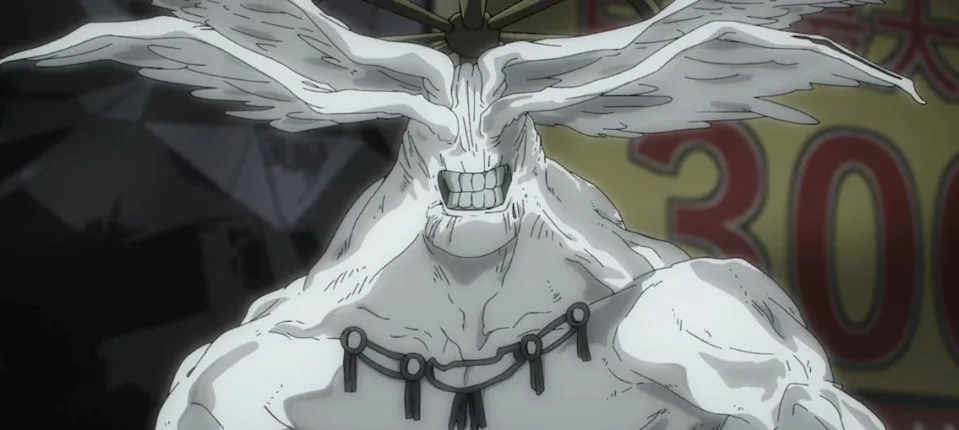
Mahoraga is not simply a strong shikigami. Its defining trait is adaptation.
Adaptation in Jujutsu Kaisen is effectively an engine for solving technique interactions. When Mahoraga adapts to a phenomenon, it becomes increasingly capable of countering it.
Infinity is one of the hardest phenomena in the series to counter reliably. Mahoraga provides a path because it can:
- Take repeated exposure to Infinity
- develop responses that no ordinary technique user could “invent” quickly
- Demonstrate a functional method that works in combat conditions
Sukuna’s genius is not merely summoning Mahoraga. It is recognizing that Mahoraga can function as a living research tool.
A clear way to understand the strategy is:
- Put Mahoraga into repeated contact with Infinity.
- Let adaptation evolve to the point where it produces a workable counter.
- Observe the principle behind that counter.
- Translate the principle into Sukuna’s own technique, so Sukuna can execute it directly.
This is the hinge of the entire fight.
Mahoraga is the reason the solution becomes available, but Sukuna is the one who makes the solution lethal.
Why people say “Mahoraga killed Gojo” and why the canon answer is still Sukuna
This debate persists because it is easy to confuse “the decisive factor” with “the direct killer.”
Mahoraga is the decisive factor in the sense that it provides the method. Without adaptation, Sukuna would have a much harder time producing a reliable Infinity bypass that also ends the fight instantly.
But the story frames Sukuna as the agent who:
- chooses the strategy
- forces the conditions needed for adaptation
- understands what the adaptation implies
- performs the final technique that kills Gojo
So the most accurate, non-argumentative summary is:
- Mahoraga makes the method possible.
- Sukuna kills Gojo using that method.
If you are answering the literal question “who killed Gojo Satoru,” the answer is Sukuna.
The death reveal: why it feels sudden to many readers
Gojo’s death is presented in a way that prioritizes emotional shock and thematic framing, then follows with mechanical explanation.
Readers experience it as sudden for three reasons:
- The chapter transition places a reflective scene first, which feels like an epilogue, before confirming the physical outcome.
- The physical outcome is extreme and immediate, leaving no gradual descent.
- The mechanism is explained after the fact, which can feel like the story is asking you to accept the result first, then understand it.
If you reread the fight in one sitting, the logic is easier to track. When reading weekly, the emotional whiplash becomes stronger because the gap between chapters amplifies expectations.
This is also why reading on ComicK, with quick chapter-to-chapter navigation, makes the sequence clearer. The fight is dense, and the ending works better when you can immediately connect setup and payoff.
Why Gojo could not simply heal through it
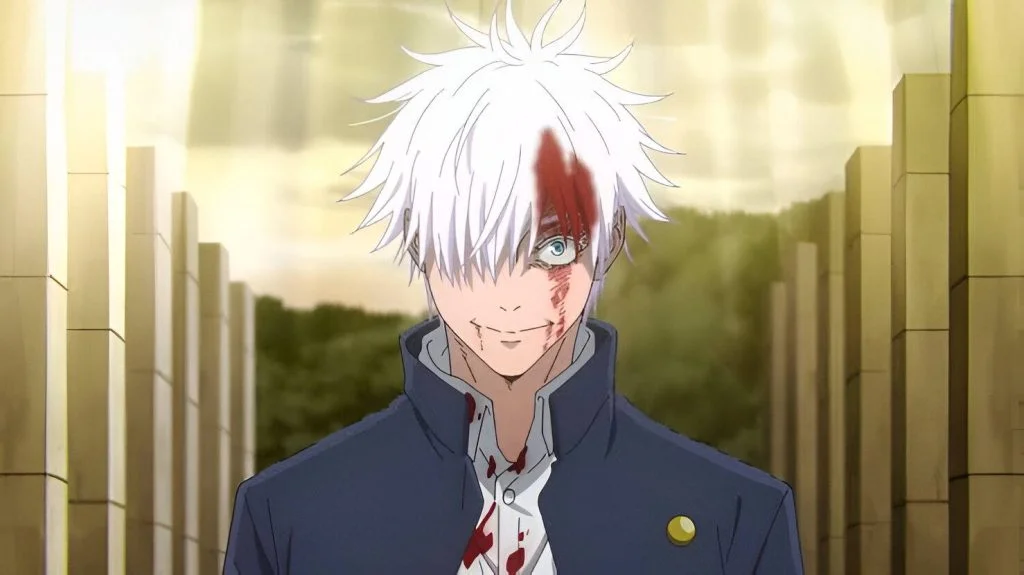
A common reaction is: “Gojo can use Reverse Cursed Technique. Why didn’t he recover?”
Reverse Cursed Technique is powerful, but it has limits. Healing requires:
- sufficient output
- time, even if brief
- intact structures necessary to sustain life and perform the technique
Gojo’s fatal injury is presented as catastrophic and decisive. The story is not showing a wound that leaves room for a recovery sequence. It is showing the end of the duel.
Also, in high-level fights, the point of a finishing move is to deny recovery. Sukuna’s win condition is built to be final, not incremental.
Why Gojo did not dodge the fatal slash
Another common reaction is: “Gojo has the Six Eyes, insane perception, and combat speed. How does he not avoid it?”
The story does not slow down into a detailed dodge sequence, so the best explanation must be consistent with what is shown and with how Infinity shapes Gojo’s behavior:
- Gojo’s default state in combat relies on Infinity as a stable protection layer.
- Sukuna’s method changes the nature of the threat so it does not behave like a normal incoming attack.
- The fight is already happening at extreme speed and complexity, with repeated domain shifts, technique interactions, and adaptation pressure.
In short, the fatal strike is framed as a qualitative change in threat type, not as a standard projectile that Gojo should obviously sidestep.
What makes Sukuna the only opponent who could plausibly do this
Many villains have ambition. Few have the combination of resources and execution to match Gojo.
Sukuna’s success comes from stacking advantages:
Mastery and improvisation
Sukuna does not fight like a character who has one fixed plan. He fights like someone willing to burn resources to gather information, then pivot when the data produces a better win line.
Ruthless patience
Against Gojo, a reckless approach fails. Sukuna’s willingness to play a long game is crucial. He can take exchanges that look unfavorable if they move the adaptation clock forward.
Access to Ten Shadows
This is the amplifier. Ten Shadows is not just extra firepower. It is a system that includes Mahoraga, which is uniquely suited to solving Infinity.
A finishing move designed to be decisive
Once Sukuna has a workable bypass, he uses it in a way that ends the fight. This is not a “chip damage” solution. It is an execution.
What the fight says about Gojo as a character
Gojo is often reduced to power scaling, but his role is more thematic than numeric.
He embodies an idea: being the strongest creates isolation, expectation, and pressure that no one else can fully share. The fight against Sukuna is not only a contest of techniques. It is also the moment where Gojo’s identity as “the strongest” meets its limit.
That is why the death lands as more than a battle result. It changes the emotional center of the story:
- The safety net is gone.
- The next generation cannot rely on Gojo’s presence.
- Victory against Sukuna can no longer be imagined as “Gojo will handle it.”
From that point forward, the story becomes a different kind of survival narrative.
What Gojo’s death changes for the Jujutsu Kaisen world
When Gojo falls, the practical consequences are immediate:
- The remaining fighters lose their most dominant asset.
- The enemy’s credibility and threat level spikes instantly.
- Every plan becomes more desperate, because the strongest possible “answer” has already been defeated.
It also changes the psychological landscape:
- Allies have to fight while carrying the weight of witnessing the strongest lose.
- Enemies gain momentum, confidence, and fear-factor.
- The tone shifts toward sacrifice and attrition.
This is why Gojo’s death is treated as a turning point, not a plot detail.
A clear reread guide on ComicK for understanding the logic
If you want the cleanest comprehension, reread with a specific focus rather than trying to absorb everything at once.
When reading on ComicK, prioritize these checkpoints:
- Watch every moment where Mahoraga is relevant. Treat those panels as the fight’s hidden core.
- Track changes in what is being tested. Sometimes Sukuna’s actions make more sense as experiments than as attempts to deal immediate damage.
- Pay attention to the moment the fight stops being about “can Sukuna touch Gojo.” Once Infinity is no longer absolute under the current conditions, the fight becomes a race to a finishing method.
- Read the conclusion twice. The explanation is dense, and a second pass often makes the targeting concept click.
This approach reduces confusion and makes the ending feel like a payoff to a long adaptation setup rather than a random twist.
If you want something with similar intensity on ComicK
After a major turning point like Gojo’s death, many readers look for series with similar pressure, strategy, and dark supernatural atmosphere. On ComicK, the categories that tend to match that feeling include:
Dark fantasy
Stories where power has a cost and victory feels expensive.
Supernatural action
Series built around exorcism, entities, curses, and escalating threat hierarchies.
Battle-driven shonen
Long-form rivalries, training payoffs, and structured arc climaxes.
Horror and occult
If the curse ecosystem was your favorite part, this leans harder into dread and mystery.
Psychological thriller
For readers who want mind games, traps, planning, and reversals.
FAQ (10 questions) about who killed Gojo Satoru
1) Who killed Gojo Satoru?
Ryomen Sukuna killed Gojo Satoru.
2) Did Sukuna really kill Gojo, or was it Mahoraga?
Sukuna kills Gojo directly. Mahoraga’s adaptation is a key enabler that provides the method.
3) How did Sukuna get past Infinity?
By using a slash that changes targeting from Gojo’s body to the “world” or space Gojo occupies, bypassing Infinity’s usual protection.
4) Was Gojo killed by Ten Shadows?
Ten Shadows is part of the strategy, but the killer is Sukuna. Ten Shadows is the toolset that helps create the bypass.
5) Why couldn’t Gojo heal with Reverse Cursed Technique?
The fatal injury is presented as catastrophic and decisive, leaving no realistic recovery window.
6) Why didn’t Gojo dodge the final attack?
The attack is framed as a different type of threat that does not behave like a normal incoming strike. Infinity-based assumptions and the fight’s speed also matter.
7) Did Kenjaku kill Gojo?
No. Kenjaku’s role is strategic and indirect. The direct kill in Shinjuku is Sukuna’s.
8) Did Toji kill Gojo?
Toji nearly killed Gojo in the past, but Gojo survived. The confirmed death in the main story comes from Sukuna.
9) Why is Gojo’s death so important to the story?
Because Gojo functions as the world’s strongest stabilizer. His loss raises stakes, removes the safety net, and forces other characters into the true endgame.
10) What is the simplest one-line answer?
Sukuna killed Gojo Satoru by using an Infinity-bypassing slash derived from Mahoraga’s adaptation.
Who killed Gojo Satoru? Sukuna did.
The deeper truth is that Sukuna wins by solving Infinity, not by overpowering it in a straightforward way. Mahoraga’s adaptation provides the blueprint, and Sukuna turns that blueprint into a fatal, world-targeting slash that ends the duel.
If you want, I can also rewrite this into a more story-driven version with more emotional narration and scene-style pacing, while keeping the same canon accuracy and without adding any meta commentary.
You may also like:
Who Is the Strongest Character in JJK? A Clear, Defensible Answer for Power Scaling Debates
How Did Gojo Satoru Make Hollow Purple? Jujutsu Kaisen Technique Guide
How Tall Is Gojo Satoru? Official Height in JJK

Jessica is a content editor at ComicK, with experience tracking and curating information from a wide range of Manga, Manhwa, and Manhua sources. Her editorial work focuses on objectivity, verifiable information, and meeting the needs of readers seeking reliable insights into the world of comics.